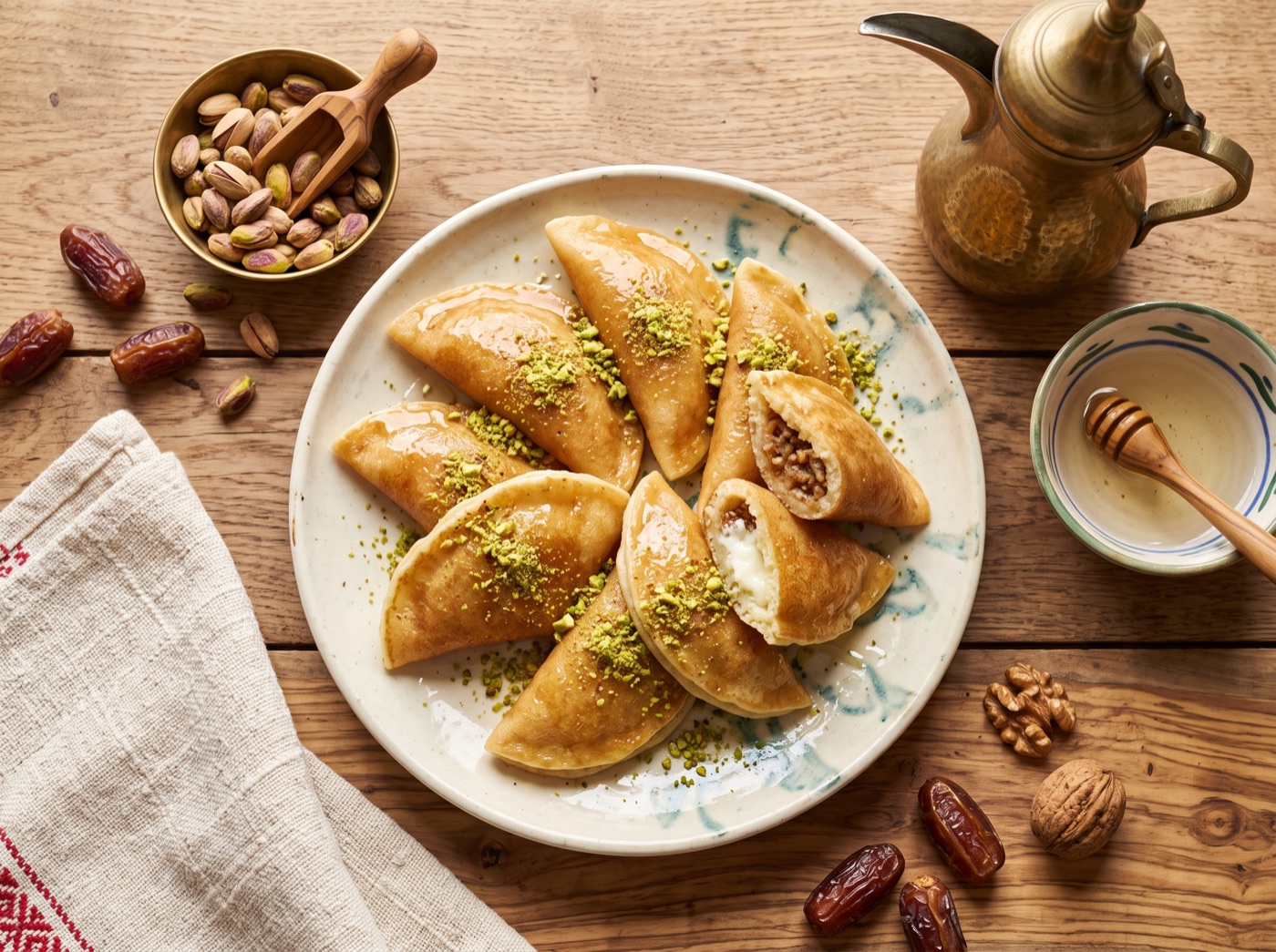
Qatayef
Stuffed Ramadan Pancakes in Sugar Syrup
Qatayef are the pancakes that announce Ramadan across Palestine, sold warm from street carts and stacked high in every bakery once the fast is broken. A yeasted semolina and flour batter is poured onto a hot dry griddle and cooked on one side only, leaving a lacy, bubbled surface that catches whatever filling you spoon in. The two classic choices are a spiced walnut mixture and a mild sweet cheese, and once folded the little half-moons are either fried until crisp or baked until golden, then dipped in fragrant sugar syrup and finished with a shower of ground pistachio.
Method
Make the syrup first so it has time to cool. Combine the 2 cups sugar and 1 cup water in a small saucepan over medium heat and stir just until the sugar dissolves. Bring to a boil, then stop stirring, lower the heat, and simmer for 6 to 8 minutes until slightly thickened but still pourable. Take off the heat, stir in the lemon juice, orange blossom water, and rose water, and set aside to cool completely.
Make the batter. Blend the flour, semolina, 1 tablespoon sugar, yeast, baking powder, baking soda, and salt with the lukewarm water until completely smooth, either in a blender or with a whisk. The batter should be thinner than a standard pancake batter, closer to the consistency of light cream, so add a splash more water if it seems thick. Cover and rest in a warm place for 30 to 45 minutes, until the surface is covered with small bubbles.
Prepare the fillings while the batter rests. For the walnut filling, stir together the chopped walnuts, 2 tablespoons sugar, cinnamon, and 1 teaspoon orange blossom water. For the cheese filling, if using akkawi, soak it in cold water for a few hours ahead and change the water a few times to draw out the salt, then drain, shred, and toss with the 1 tablespoon sugar if you like a sweeter cheese.
Cook the pancakes on one side only. Heat a nonstick or well-seasoned skillet over medium heat with no oil. Pour in about 2 tablespoons of batter for each pancake, letting it spread into a round of roughly 4 inches. Cook without flipping for 1 to 2 minutes, until the top loses its shine, sets fully, and is covered in open bubbles while the underside turns light golden. Move each finished pancake to a clean towel and keep them covered so the edges stay soft and pinchable.
Fill and seal while the pancakes are still warm. Hold a pancake bubble side up and place about 1 tablespoon of filling on one half. Fold it into a half-moon and pinch the curved edge firmly from end to end to seal, making sure no filling peeks out. Cheese qatayef are often left open at the top and finished with pistachio, while walnut qatayef are sealed all the way around before frying.
Fry the qatayef. Heat 1 1/2 to 2 inches of neutral oil in a deep skillet to about 350 F. Fry in batches, without crowding, for 2 to 3 minutes per side, turning once, until deep golden and crisp. Lift out and drain briefly on a rack or paper towels. To bake instead, brush the sealed pieces with melted butter or oil and bake at 400 F for 12 to 15 minutes, turning once, until golden.
Dip and finish. While the qatayef are still hot, lower each piece into the cooled syrup for a few seconds, turning to coat, then lift out so they soak up sweetness without going soggy. Arrange on a platter and scatter generously with ground pistachios. Serve warm.
Cook’s notes
- The griddle stays completely dry, so wipe it clean between batches and keep the heat moderate. If the pancakes brown too fast the tops will not bubble and set properly.
- Seal the walnut qatayef tightly and drain any excess soaking water from the cheese, since a loose edge will open in the hot oil and leak.
- Keep one element hot and the other cool. Hot qatayef into cool syrup gives crisp, syrup-soaked pastry, while both hot or both cold turns them heavy and wet.
- You can cook the plain pancakes a few hours ahead and keep them covered, then fill, fry, and dip just before serving so they stay at their best.
More looks
Swipe for more